Every year, as night follows day, state and federal governments from both major parties approve ever more coal mines and gas projects. The task of protecting the environment and human health from the harms caused by these projects thus falls to local community groups and environmental NGOs, who typically object to these projects and challenge them in the courts.
Often, a key aspect of such legal challenges concerns the way the decision-maker deals with the climate change impacts of the proposed project. Despite some notable victories, most of these challenges fail.
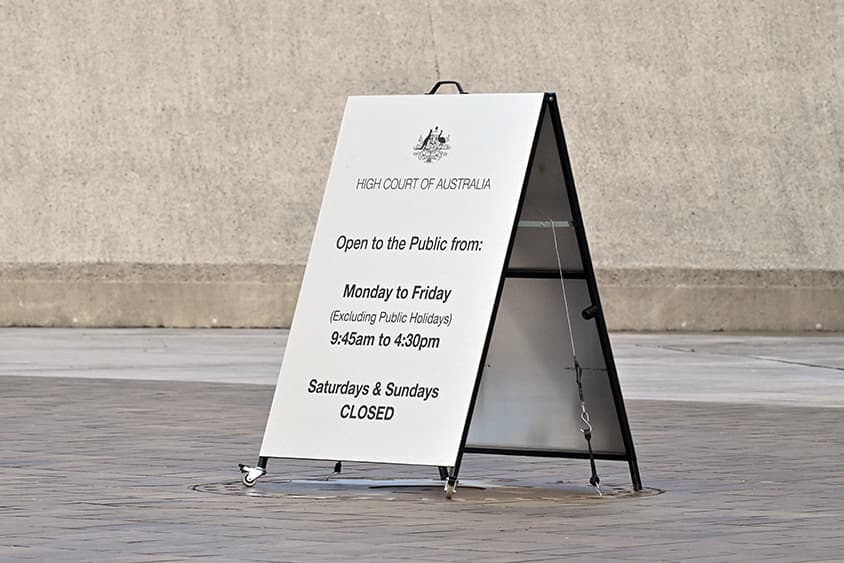
On Wednesday, the High Court of Australia—the nation’s highest court—for the first time heard one such case. The case involved a challenge by a local community group to the approval by the NSW Independent Planning Commission (IPC) of the proposed extension to the Mount Pleasant coalmine in the Hunter Valley. The NSW Court of Appeal had overturned the approval, and the coal company appealed to the High Court.
Parties seeking to appeal lower court decisions don’t have an automatic right to be heard by the High Court; they first have to apply for permission to be heard through what’s called an application for special leave to appeal. Each year, the Court hears around 800 such applications and grants leave in only around 50 cases, which it perceives raise legal issues of national significance. The fact that the Court granted leave in this climate case is therefore notable in itself.
Also significant was the fact that the Court granted leave to three groups with expertise in factual and legal issues concerning climate change to appear as amicus curiae (“friend of the court”)—something the Court does quite rarely. I’m a member of one of these groups, Melbourne Climate Futures (where I’m a Visiting Fellow), so I attended Wednesday’s hearing with great interest.
Our submissions spoke to the relevance to the case of international law and of case law from other jurisdictions. While the High Court’s decision won’t be handed down for some time (probably a few months), the exchanges between the judges and counsel during the hearing revealed some interesting insights.
As the hearing proceeded, two main sets of contentious issues came to the fore. The first concerned the proper assessment of climate impacts from a fossil fuel extraction project. The IPC had considered the impacts of the project’s emissions on climate change in a global sense, i.e., on average global surface temperature. The issue before the High Court was whether the IPC should (legally), and could (given the state of climate attribution science), have also considered the further impacts of that global warming on particular environmental conditions in NSW, such as increased risk of bushfires and changed rainfall patterns.
This matters because the Court’s finding on this point will set a precedent as to the required scope of climate impact assessment that proponents of emissions-intensive projects in NSW must undertake, and that administrative decisionmakers must consider. This includes future coal mine extensions, of which there are currently 18 proposed in NSW. The Court’s finding will also influence how similar provisions in other Australian state, territory and federal environmental impact assessment regimes are interpreted, with potential implications for, in particular, offshore gas production.
The second set of issues concerned whether the IPC should have considered, and whether it did in fact consider, whether to impose conditions on the approval concerning the mitigation of the subset of greenhouse gas emissions caused by the project that stem from the downstream combustion of the extracted coal.
These indirect emissions are known as ‘scope 3 emissions’, as distinct from the emissions that directly occur within the project’s boundary (‘scope 1’, such as the fugitive methane emitted in the process of mining the coal) and any indirect upstream emissions from the generation of electricity supplied to operate the coalmine (‘scope 2’). It was common ground that 98% of the emissions caused by the project were the scope 3 emissions, and that most of those emissions would be caused overseas, when the exported coal is combusted.
Importantly, the IPC dismissed concerns about the climate impacts of the project’s scope 3 emissions on the ground that “under the Paris Agreement, Scope 3 emissions are attributed to the country within which they are emitted” (at para. 153). This kind of argument is commonly made by fossil fuel producers in these kinds of cases around the world. However, as the Queensland Land Court held in a similar case decided in 2022, that argument is predicated on a misunderstanding of countries’ international climate obligations, which are not limited to their Nationally Determined Contributions under the Paris Agreement.
Moreover, as the International Court of Justice (ICJ) found in its 2025 Advisory Opinion on the Obligations of States in respect of Climate Change, states have a customary international law duty to prevent significant harm to the climate system. This duty, the ICJ held, extends to the assessment of risks arising from emissions-intensive projects, including fossil fuel extraction projects and their downstream effects. In any event, as courts in the UK and Europe have recognised in similar cases, the relevant statute in each jurisdiction requires the fossil fuel company to identify the environmental impacts its project will cause and to propose appropriate mitigation measures, and requires the decision-making authority to consider relevant conditions for such mitigation; there is no statutory basis for that responsibility simply to be outsourced to third countries.
It is hoped that the Court sees the force of these responses to the coal company’s argument and recognises that Australia and the companies that mine its coal (and drill its gas) bear considerable legal responsibility for causing and mitigating the climate harm emanating from the use of their products, wherever that may occur.
Dr Fergus Green is an Associate Professor in the Department of Political Science and School of Public Policy at University College London and a Visiting Fellow at Melbourne Climate Futures, which appeared as amicus curiae in the hearing.