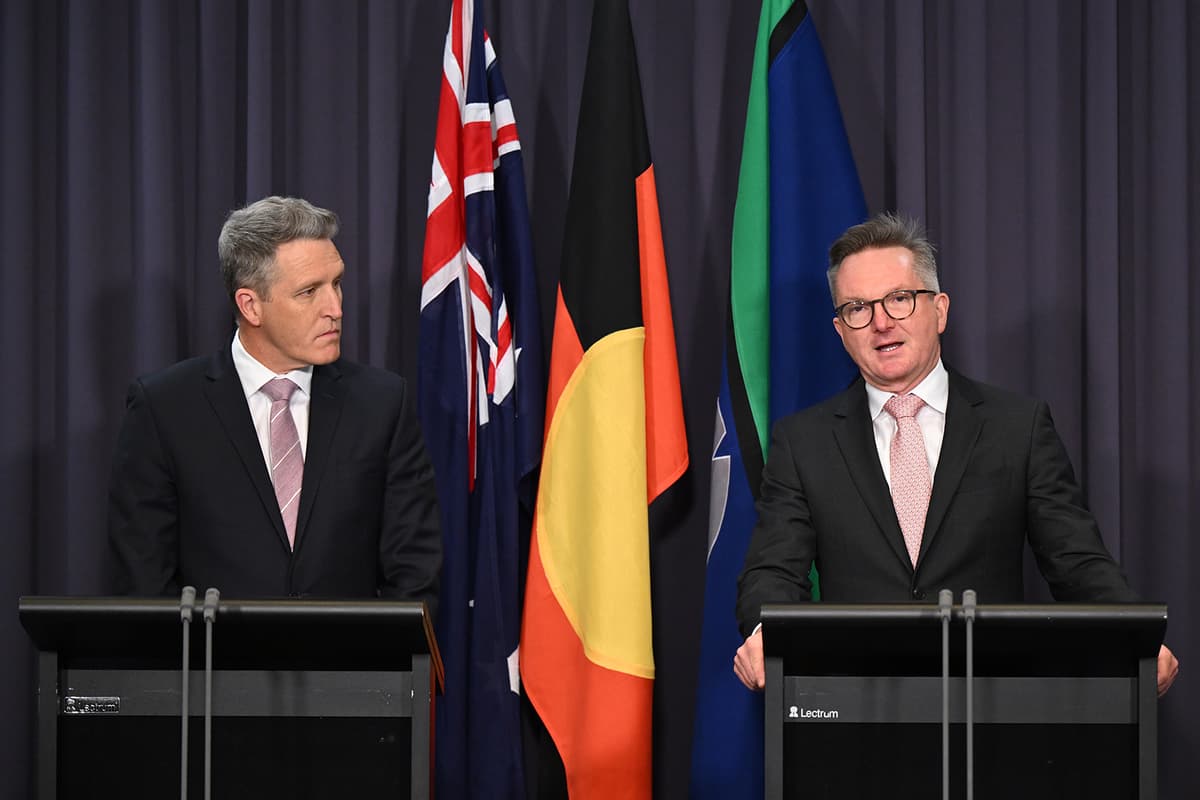
In June, Assistant Climate Change Minister Josh Wilson changed the law around how carbon credits work. The changes would allow the NSW Government’s proposed Great Koala National Park to raise revenue by selling carbon credits to big polluters, so the polluters can claim to have “offset” their greenhouse gas emissions.
Called the “Improved Native Forest Management” method, the new law undermines a fundamental principle of Australia’s scheme: that carbon credits should only reward “additional” effort. This additionality requirement is important as carbon credits are supposed to be a payment for reducing carbon emissions, and big polluters can buy them to escape their obligations to cut actual emissions.
For example, as Four Corners recently exposed, BHP cancelled plans to electrify its mining trucks because it was cheaper and easier to buy offsets instead.
NSW Labor committed to establish the Great Koala National Park back in 2015, without strings attached. It was only in 2025 that they began claiming the park would not go ahead without carbon credits. Normally if something was going to happen anyway, like a national park that’s been promised for a decade, then there wouldn’t be any credits awarded for doing it because the park is clearly not ‘additional’ to what was going to happen anyway.
Giving away carbon credits for things that the NSW Government had already promised is like offering your kids $50 to do the chores they were already expected to do.
For the national park to generate lucrative carbon credits, Labor needed to change the law – and they have.
But how can an assistant minister in the Albanese Government change the law by themselves, and why are some people hoping the Senate will change it back?
Disallowance motions
In theory, the democratically elected Parliament makes the laws, and the appointed ministers implement them.
In practice, it would be prohibitively difficult for all the legislation required to run the country to go through Parliament. Instead, government ministers are empowered to make certain laws, called “delegated legislation”.
Among those government-made laws are the new carbon credit rules for national parks and other forests, the Improved Native Forest Management (INFM) method.
Delegated legislation is limited in two ways.
Firstly, ministers can only make delegated legislation when Parliament has already given them that power over a particular subject matter.
For example, Parliament described the broad intent of the Medicare scheme in the Health Insurance Act 1973 but left to the minister to specify exactly what health services are subsidised by the government (the Medicare Benefits Schedule).
Secondly, Parliament has a narrow window to “disallow” most types of delegated legislation. After a minister makes a new law, any parliamentarian can give notice that they will bring a “disallowance motion”. If no one gives notice within 15 sitting days, the delegated legislation will remain in place indefinitely.
The Senate keeps a list of delegated legislation that is still within the 15 sitting days window, and therefore still disallowable.
If there is a disallowance motion, a new timer starts: 15 sitting days to vote on the motion. If a majority of parliamentarians in either the Senate or the House of Representatives vote for a disallowance motion, or if there is a motion announced that never gets to a vote, then the new law in question is torn up.
The Parliament also keeps a list of all disallowance motions for the year and when a vote was held or is expected to be held.
And while Parliament is often the site of inter-party politics, disallowance motions are often the exception. The multi-party Committee for the Scrutiny of Delegated Legislation works across party lines to negotiate improvements to delegated legislation – with the anticipation of disallowance if the government does not make the improvements.
Narrow window for disallowance motion
A disallowance motion scheduled for vote in the Senate on Tuesday 18 August could stop these new, dodgy changes to how carbon credits are created and given away. Introduced by the National Party, it would roll back the INFM method.
If Liberal, National, Green and crossbench senators unite, they can pass the disallowance motion and keep the carbon credit laws as they were. The promised Great Koala National Park could still go ahead, but without creating any of the carbon credits that help companies keep polluting.
A motion to disallow is purely procedural in nature, without the emotive or ideological language sometimes used in other types of motions. That’s appropriate, since there are varied and even competing reasons for supporting a disallowance motion.
Put simply, a wide range of people might agree that something is a bad idea without necessarily agreeing on why it is a bad idea.
Among them is National MP Alison Penfold, who said:
There are many people across the North Coast who genuinely support the creation of the Great Koala National Park, but supporters of the park should also be asking some serious questions of the Minns Labor government. … Supporters of the park should not have their aspirations tied to a methodology that leading experts say contains fundamental flaws.
She has an unlikely ally in Bob Debus, the former long-serving NSW Labor Environment Minister. He wrote in The Point that:
This perverse interpretation allows the INFM method to generate credits for abatement as if unconditional protection had not already been promised on numerous previous occasions.
Independent MPs Andrew Wilkie and Nicolette Boele have also criticised the changes.
The people elected the Parliament to make laws, and ministers depend on Parliament’s consent to change the law.
Politicians who are concerned about greenwashing and due process have the power to stop the dodgy national parks deal later this month, but only if a range of senators vote together. Luckily for those opposed to the creation of even more carbon offsets, the Senate has a long tradition of unlikely senators coming together to agree that a minister’s latest idea is a bad one.
Bill Browne is the director of the Democracy & Accountability program at the Australia Institute