Although politicians are not popular, there are good reasons to want more of them. The Australian population has grown by 11 million since the last increase in the number of politicians, leaving local members stretched thin.
Thu 12 Feb 2026 01.00
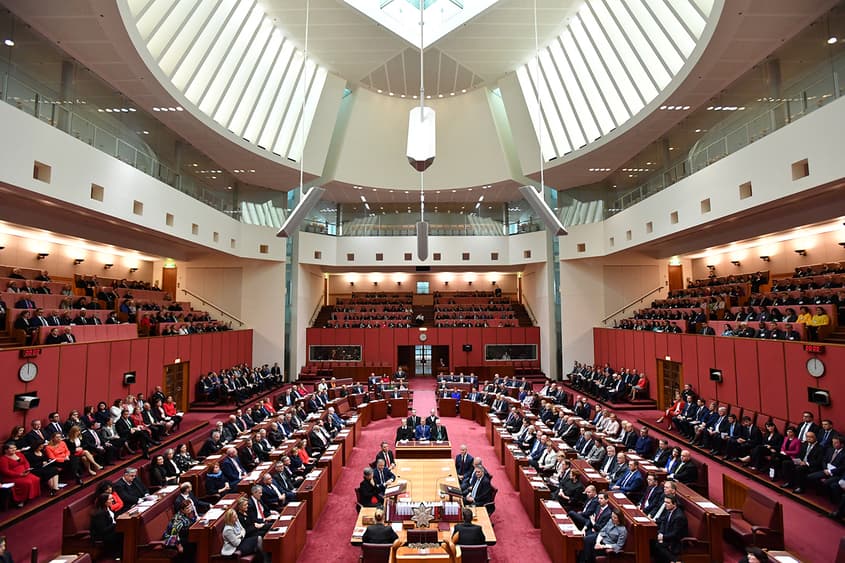
Photo: AAP Image/Sam Mooy


Although politicians are not popular, there are good reasons to want more of them.
The Australian population has grown by 11 million since the last increase in the number of politicians, leaving local members stretched thin.
With about 125,000 voters per electorate, it’s no wonder most people have never met their local member, cannot name them and would not feel comfortable contacting them with a problem.
With smaller electorates, parliamentarians would be more responsive to local needs and more vulnerable to local community campaigns. More politicians would also deepen the talent pool for ministerial and shadow ministerial positions, and allow backbenchers to specialise in particular policy areas.
The Albanese Government is taking an increase in the size of Parliament seriously.
But what are the rules for how many local MPs and senators there are in the Commonwealth Parliament, and how could they change?
Two constitutional rules dictate how the number of parliamentarians can be increased:
Currently, there are six states electing 12 senators each, for a total of 72 state senators. That provides 144 state MPs (in the House of Representatives). There are currently 145 due to rounding. I’ll get to the Territories in a moment — Territory MPs and senators are handled separately, by legislation.
To increase the number of MPs, the government must therefore increase the number of senators. And since only half the senators are elected at any given election, the number of senators per state will likely only be increased by an even number, for example plus 2 (to 14), plus 4 (to 16), plus 6 (to 18) or plus 8 (to 20).
With six states, that means the number of senators would increase by 12, 24, 36 or 48, and therefore the number of MPs would increase by (roughly) 24, 48, 72 or 96, and the overall number of parliamentarians by (roughly) 36, 72, 108 or 144.
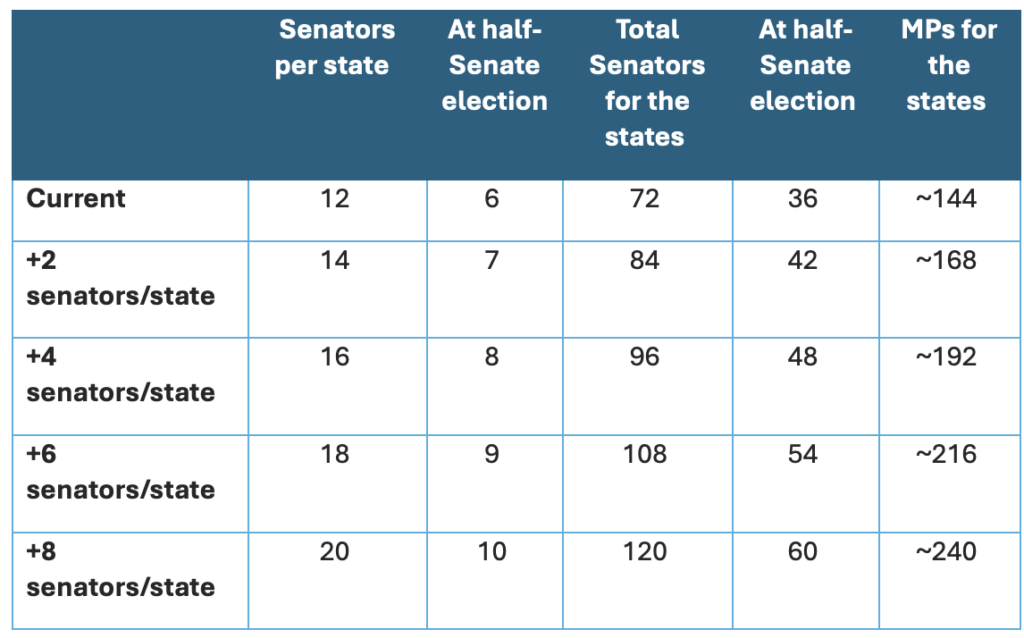
The Australia Institute’s recommendation is for the number of MPs to be increase by approximately 50% to bring representation back to 1984 levels – the last time parliament was expanded. This could be achieved through the addition of six senators per state, which would mean 108 senators and roughly 216 MPs across all six states.
Currently the 4 territory senators (2 for each of the ACT and NT) brings the total number of senators up to 76. And the 5 territory lower house MPs brings the total lower house MPs to 150l.
Because they are provided for separately, the number of territory senators could be increased without an increase in the number of state senators, or vice versa. The number of territory MPs in the House of Representatives would increase proportionately as the number of MPs overall increases, without separate action being required.
The Australia Institute has argued for the number of territory senators should be increased to at least four, if there is no change in the overall size of Parliament.
If, however, there were to be an increase in the overall size of Parliament, a further increase in territory senators would be appropriate – perhaps the territory allocation could be set at half as many senators as are received by each state. Since all territory senators are elected at each election, there is no problem with there being an odd number per territory (for example, if there are 18 senators per state there could be 9 for the ACT and 9 for the Northern Territory).
The consulting firm behind the Bureau of Meteorology’s (BoM) heavily criticised website has been awarded another multi-million-dollar government contract to build a new climate platform.
Advertisement

The easiest way to understand the structural shift taking place in Australian politics is to understand that you can now win a landslide majority of seats in parliament even when your primary vote declines.
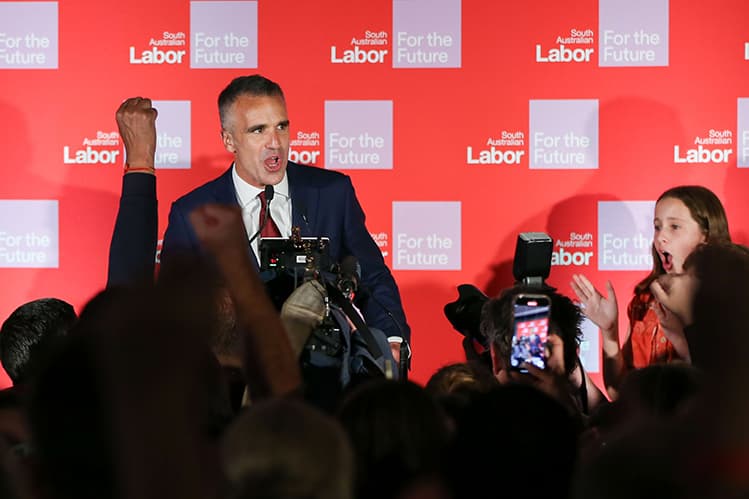
On Saturday, South Australians voted decisively to re-elect the first-term Malinauskas Labor Government. While we don’t know exactly how the 47 lower house seats will fall, Labor will have a super-majority having won about 35 seats.