During early 2026, huge billboards outside Canberra airport carried gas industry advertisements. We covered them at the time on The Point liveblog here.
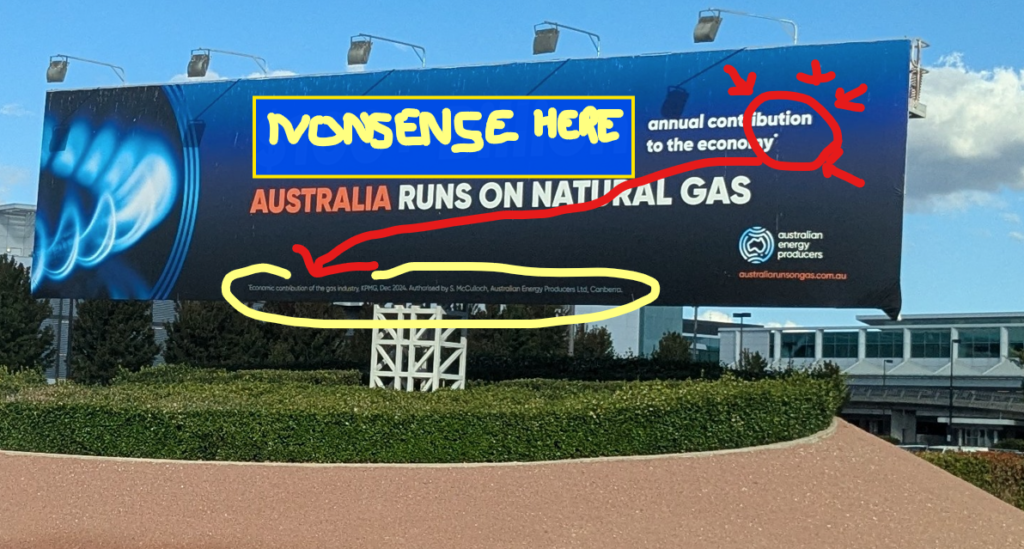
The location of these billboards was not an accident. Members of Parliament were flying into Canberra to decide whether to change taxes on gas exports and they had to drive right past these ads.
The huge billboards featured a huge number claiming to be the “contribution of the gas industry to the economy”. Below the huge number was some very fine print on where the huge numbers came from.
The huge number is $100 billion.

This is misleading for at least three reasons:
Reason 1 // It includes profits to foreign shareholders. As the gas industry is primarily foreign-owned, most of the profit ends up overseas. To state the obvious, foreign profits do not benefit Australians.
Reason 2 // The modelling behind this number is dodgy. The multiplier methodology used is so discredited that the Productivity Commission describes its misuse as “primarily relating to overstating the economic importance of specific sectors”, in this case, the gas industry. This methodology is mathematically certain to overstate positive impacts.
Reason 3 // The definition of “gas industry” in this figure includes “crude oil”, “road freight transport services”, “corporate head office management”, “office administration services” and other activities that have little to do with gas exports.
So, claiming foreign profits as Australian, dodgy modelling and including non-gas activities in the ‘gas industry’. Where did this come from?
The fine print on the billboard shows that these numbers come not from official statistics, but from a report commissioned by gas industry lobby group Australian Energy Producers. The report was written by consultants KPMG. KPMG’s disclaimer on page 2 is worth a read:
“No warranty of completeness, accuracy or reliability is given in relation to the statements and representations made by, and the information and documentation provided by Australian Energy Producers as part of the process. KPMG has indicated the sources of the information provided within this work. We have not sought to independently verify those sources unless otherwise noted within the work.”
In other words, KPMG have accepted the data their clients gave them and used a methodology that their clients asked for, and are claiming that they are not to blame if these numbers are used on enormous billboards that could mislead policymakers and the public.
This is nothing more than major consultants joining big gas in taking the piss.
A 25% tax on gas exports, as proposed by the Australian Council of Trade Unions and supported by many Members of Parliament would provide major benefits to Australia and end claims of a gas shortage. This would come at virtually no cost to anyone other than multinational gas corporations.