Advanced search
The Point - home
DonateSubscribe
HomeWhat's NewOpinionOff the ChartsExplainersFactcheckAbout Us
The Point — home
DonateSubscribe
The Point — home
Advanced search
  • Home
  • What's New
  • Opinion
  • Off the Charts
  • Explainers
  • Factcheck
  • About Us
DonateSubscribe
Subscribe
  • Home
  • What's New
  • Opinion
  • Off the Charts
  • Explainers
  • Factcheck
  • About Us
The Point - home
Privacy PolicySitemapComplaints & CorrectionsNewsletter

The Point recognises the ancestral connections and custodianship of Traditional Owners throughout Australia. We pay respect to Aboriginal and Torres Strait Islander cultures and to Elders past and present.

©2025–2026 The Point, an initiative of The Australia Institute

FACTCHECK

Factcheck: Yes, Ed Husic is right. Australia exports gas so cheaply that Japanese companies profit from on-selling our gas

The claim is true. Japanese companies are on-selling a lot of Australian LNG and making a lot of profit while doing it.

By Jack Thrower

Mon 23 Mar 2026 13.48 AEDT
EconomyClimate
True
Factcheck: Yes, Ed Husic is right. Australia exports gas so cheaply that Japanese companies profit from on-selling our gas

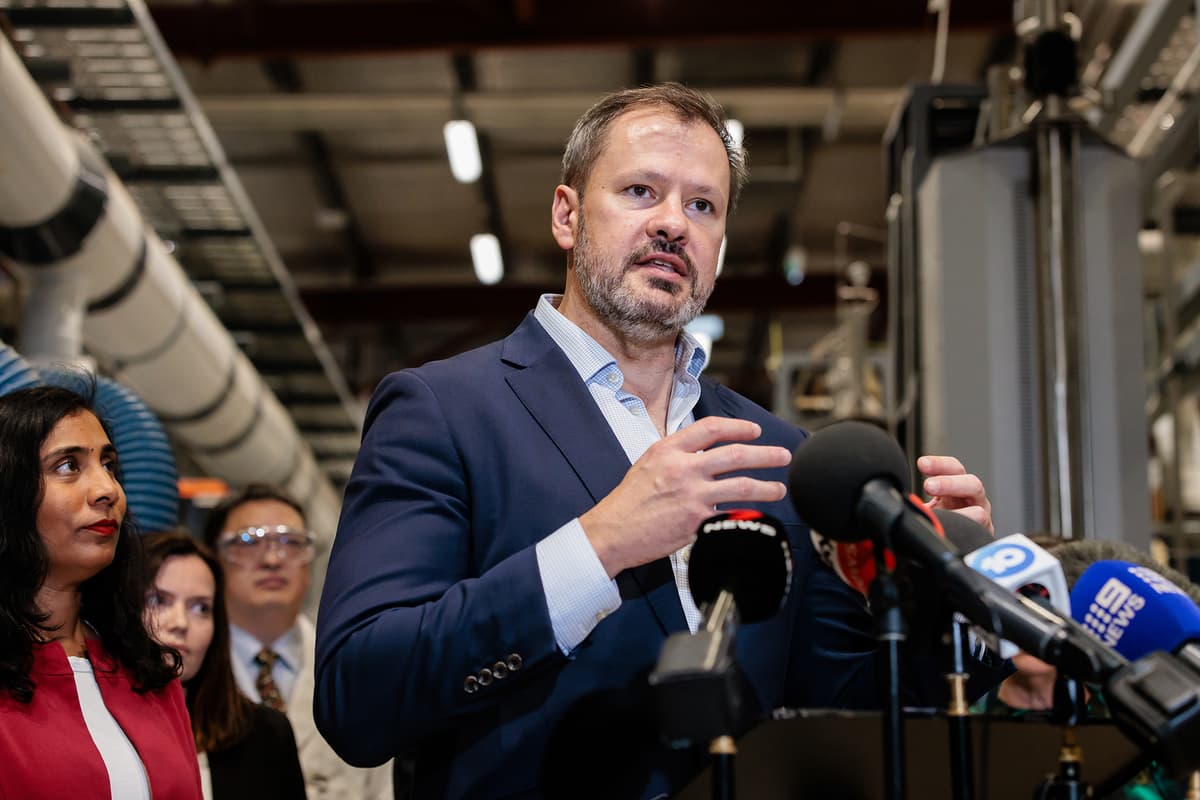
Photo: AAP Image/Richard Wainwright

Republish this article

This article is licensed under Creative Commons — Attribution-NoDerivatives 4.0 International (CC BY-ND 4.0).

Republishing guidelines

  • You must credit the author(s) and The Point.
  • You must link back to the original article.
  • You may not edit or modify the article content.
  • Images may be subject to separate copyright and are not included in this licence.

The claim:

Last year Ed Husic MP said:

[for] four consecutive years … [Japan] have on-sold Australian gas while telling us we should not have a right to intervene. … profiting from that gas while we are struggling

The facts:

The claim is true. Japanese companies are on-selling a lot of Australian liquified natural gas (LNG) and making a lot of profit while doing it.

Research from the Institute for Energy Economics and Financial Analysis(IEEFA) shows that in 2024:

  • Japanese companies on-sold 600 to 800 petajoules of Australian LNG. This is more than the total gas demand of Eastern Australia.
  • Japanese LNG resales from both Eastern and Western Australia are bigger than projected ‘gas shortages’ in future years.
  • Japanese resales likely drive more than A$1 billion in profits for these companies.

Recently, Japanese oil and gas giant Inpex even admitted to on-selling Australian gas from the Northern Territory.

How has this happened?

Further research from IEEFA shows that Japanese domestic demand for gas has fallen dramatically, as restarted nuclear reactors and deployment of renewables have displaced gas-fired generation.

Instead, Japanese LNG buyers are now cultivating demand for gas in nearby markets such as South Korea and Taiwan and profiting while doing so. Indeed, the Japanese Government is actively encouraging LNG buyers to continue to buy large volumes of LNG and on-sell them.

The verdict: True. Australia exports gas so cheaply that Japanese companies profit from on-selling our gas.

Advertisement

Related Articles

OPINION

ASIC is finally opening Big Oil & Gas’ books. Here’s why that’s a very big deal

By Amanda Holly

For the first time, the corporate regulator is checking whether these companies are telling the truth about what it will cost to remove the wells, pipelines and platforms they have left scattered across Australia’s seafloor. It is the most significant intervention into the sector’s clean-up accounting this country has seen, and it could rewrite the balance sheets of some of our biggest fossil fuel companies.

Climate
ASIC is finally opening Big Oil & Gas’ books. Here’s why that’s a very big deal

OPINION

Browse keeps changing its story

By Alex Hillman

In the past year, the new Browse gas project at Scott Reef has been pitched as the answer to a West Australian gas shortfall and as backfill for the ageing North West Shelf. Yet more than 50 years after discovery, and after $2.5 billion in development costs, it still hasn’t reached a final investment decision or FID, as it’s called. That usually says something about a project’s viability.

Climate
Browse keeps changing its story

OPINION

You can’t fix what you won’t name: COP31 program omits the words 'fossil fuels'

By Louise Morris

Imagine a fire brigade holds a crisis summit about the damage caused by fire, and how to fight fire, and bans the word “fire” from the agenda... That’s where we are with COP31.

Climate
You can’t fix what you won’t name: COP31 program omits the words 'fossil fuels'

WHAT'S NEW

Australia risks repeating New Zealand's mistakes as ACTU warns against further rate hikes

By Tegan George

The Australian Council of Trade Unions (ACTU) has warned against further interest rate rises, with new research estimating that almost 900,000 fewer Australians would be in full-time work if the country had followed New Zealand’s economic path.

Economy
Australia risks repeating New Zealand's mistakes as ACTU warns against further rate hikes


