Right now, right across the country, communities are being forced to come to terms with the rapidly escalating frequency, intensity and cost of climate disasters.

Mon 23 Mar 2026 07.00
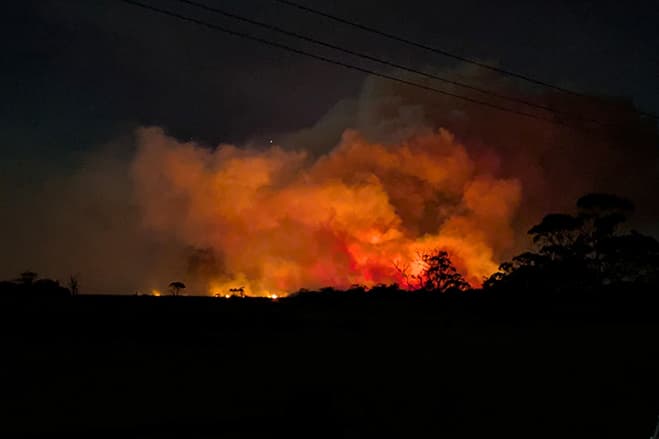
Photo: bushfire in Dolphin Sands, Tasmania, Friday, December 5, 2025. (AAP/Tasmania Fire Service)


Right now, right across the country, communities are being forced to come to terms with the rapidly escalating frequency, intensity and cost of climate disasters.
Bushfires, floods, storms, droughts and marine heatwaves are inflicting growing damage on fisheries, farms, homes, critical infrastructure and local economies. We’re seeing it almost constantly, even right now with the seemingly never-ending floods in Northern Australia. And the human and financial toll is staggering.
In fact, climate-related disasters are already estimated to cost around $38 billion a year in Australia, or about 2 per cent of GDP. And that figure is only expected to grow.
Indeed, insurance claims from extreme weather in the 2020s have averaged $4.5 billion annually, about triple the levels of the 1990s.
And nowhere is the rising risk of climate change clearer than in my community of Greater Hobart in Tasmania. Bushfire is an ever-present risk. Hobart still retains some of the scars of the 1967 Black Tuesday fires which killed 64 people and destroyed over 1,200 homes, leaving thousands homeless.
Today the Tasmanian Fire Service estimates that 98 per cent of the state is bushfire prone. Alarmingly, projections suggest a 40 per cent increase in extreme fire danger days in Tasmania by 2050.
This risk, of course, comes as no surprise to Tasmanians themselves, with one in six living within 50 metres of the bush. And with Greater Hobart widely regarded as one of the most bushfire-prone cities in the world, more than 4,000 buildings today face at least moderate bushfire exposure.
If you add to this the increased risk in Tasmania of longer droughts, marine heatwaves, floods, storms and other extreme weather events, it’s no wonder insurers are sounding the alarm.
Appallingly, the cost burden for mounting climate disasters keeps falling on the same people: taxpayers, ratepayers and households. And the costs of insurance, of rebuilding and recovery after disasters and of investing in mitigation measures are all rising rapidly.
At the same time, the fossil fuel companies whose products are driving the climate crisis pay a pittance in tax. We’ve seen in recent weeks, amid global energy shocks and geopolitical instability, many fossil fuel producers recording record windfall profits.
These companies contribute significantly to climate damage and profit handsomely from global instability, but they don’t contribute in any meaningful way to the costs of the damage they cause. In fact, they continue to enjoy generous tax rates and concessions which are granted to few others, let alone ordinary taxpayers.
A Climate Disaster Levy, as proposed by the Australia Institute, is a bit of a no-brainer really. It would be placed on fossil fuel exports so that the companies whose products turbocharge climate change finally contribute to the costs of the disasters they help to cause. And I think most Australians would agree that’s only fair.
Analysis from the Australia Institute shows that a strong levy applied to fossil fuel exports could raise up to $100 billion each year. At more conservative estimates, it’d be at least tens of billions each year.
That’s money that could be invested in preparedness, mitigation, response and recovery. And it’s money Australians won’t be forced to fork out to insure for and cover the damage caused by multinational companies.
At a time when most Australians are struggling with the cost of living, it’s pretty difficult to justify allowing enormously profitable fossil fuel corporations to walk away from the consequences of the damage associated with their products.
Now, I’m not saying a Climate Disaster Levy would solve the climate crisis on its own. But it would restore a measure of fairness to the system.
Because as climate disasters intensify, the question isn’t whether we can afford to act. The real question is why Governments continue to allow the biggest climate vandals to avoid paying their fair share.
Andrew Wilkie is the Independent Federal Member for Clark in Tasmania.
Advertisement

New South Wales is the first state in Australia to ban new coal mines. The State Government announced on Friday that it will no longer consider applications for new mines or allow new coal exploration, while extensions to existing mines will still be considered.
Australia is already paying the price of climate change. The evidence appears almost daily on the national emergency map. Just this week alone, major flooding has inundated communities in Queensland, with homes and businesses flooded in Bundaberg. Flooding across the Northern Territory has forced evacuations in remote communities.
The Federal Government is facing calls to intervene and stop the expansion of a central Queensland coal mine that environmental groups have labeled a “carbon bomb”.