Shorter America This Week: Ceasefire?; Madman theory; Group hugs in space
It isn’t always easy to keep up with what’s happening in the US. “Shorter America” is a series where Dr Emma Shortis loops you in on what’s going on in America and shares news and analysis that you can trust.
Fri 10 Apr 2026 12.00
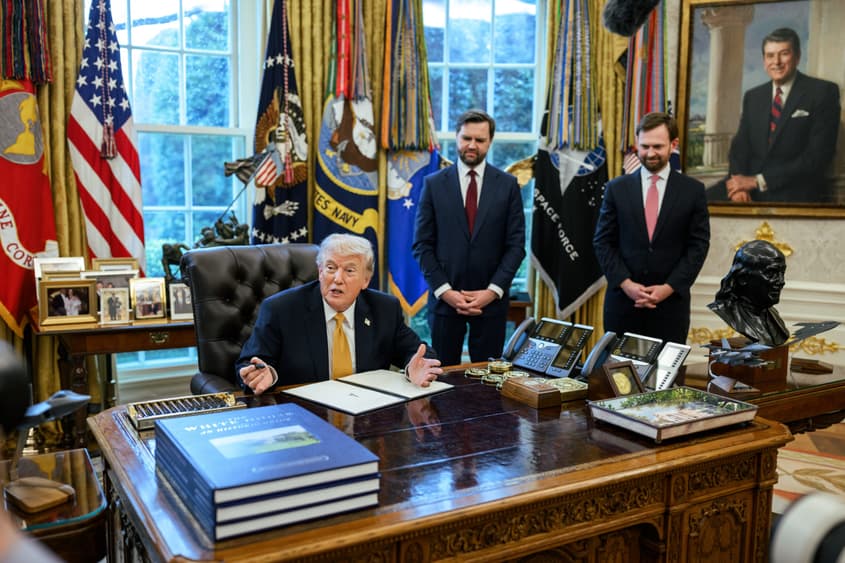
The White House/Flickr


The President of the United States threatened to commit genocide; implicit in that was a threat to use nuclear weapons. There is no “strategy” to speak of. And everyone involved is lying.
This week:
- Ceasefire?
- Madman theory
- Group hugs in space
Ceasefire?
Is there a ceasefire? Is the Strait of Hormuz open? Answering the most basic of questions about the Trump administration’s war on Iran is incredibly difficult. When Trump announced the “ceasefire” on Truth Social, he said he was working on the basis of a 10-point plan provided by the Iranian regime. That was the same plan the United States had rejected just days before. Or was it? Which version did Trump have? Was it the one that said the Strait of Hormuz would be controlled by the Iranian armed forces? Or a different, 15-point one, as the administration claimed the next day?
Did the ceasefire include Lebanon? The Pakistani PM, who brokered the initial agreement, had been clear that it did. The Iranian regime clearly thought so. But almost immediately, Netanyahu said it wasn’t and initiated a huge wave of strikes that have now killed over 300 people. I don’t think Trump had thought about it. He later said it was a “separate skirmish”. It isn’t.
This piece in Politico outlines just how fragile this “ceasefire” is, if we can even call it that. And this one from the Center for Foreign Policy shows just how far apart the Trump administration and the Iranian regime are on core issues. Nothing is certain.
But the best analysis I’ve read so far is over at Professor Elizabeth N. Saunders’ Bluesky. Saunders’ real-time analysis is as sober as it is horrifying. After Trump announced the ceasefire, Saunders observed that Trump “chose humiliation over escalation. For now. Or until he realizes he chose humiliation.” And she’s right to say that “this could end up being the most consequential event for the world in the 21st century”.
Madman theory
Lots of the coverage and analysis of Trump’s approach to this war strives to find rationality and strategy where there is none. I pointed to that in my last column, when I noted analysis that suggests Trump is “escalating to de-escalate” – that is, he’s making outrageous threats in order to force his adversaries to back down into a deal. This is often compared to Richard Nixon’s ‘Madman’ approach – that is, make your adversaries think you could do anything in order to force them to negotiate on your terms.
The problem is, for that to work, you’ve got to have an actual strategy. And clear terms. Trump has neither. All he does is keep ratcheting up the threats, cornering himself into an escalatory trap. And anyway, as David Frum puts it bluntly in The Atlantic, “the most important thing to understand about the “madman theory” of foreign policy is that it was designed by losers for losers.”
In the Irish Times, Fintan O’Toole makes an even more important point: this isn’t madness. It’s derangement.
Group hugs in space
During such a terrifying week, as Trump held us all hostage, something pretty lovely was happening out in space. If you haven’t seen them, it’s worth having a look at some of the extraordinarily beautiful photos from the Artemis II mission. The four-person crew – a DEI nightmare! – have a lovely bond. From watching them quietly cry together to how they handled the deranged president, it’s all been a real bright spot in the dark, and a reminder of a very different version of America – one that still exists.
As the Beeb put it, the mission wasn’t really about science. “Perhaps its greatest achievement…is through the actions of the Artemis crew, which have generated hope, agency and optimism for a world appearing to be in desperate need of inspiration.”
Related Articles
Australia has significant power in the world, we should be using it more wisely
Australia is not a small nation with no agency.
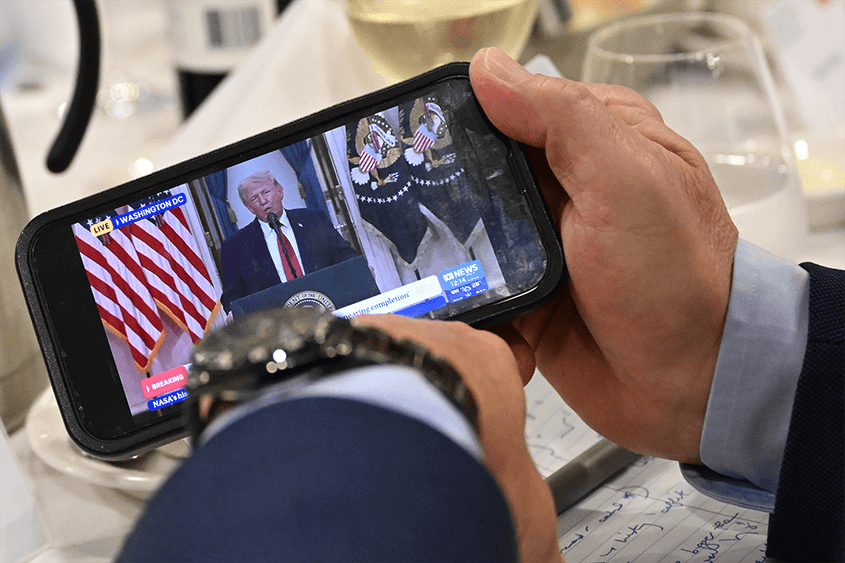
Pacific nations step up push for fossil fuel phase-out ahead of global talks
Pacific leaders are preparing to meet in Vanuatu to agree on a unified position ahead of the first global conference on transitioning away from oil, coal, and gas later in the year.