Don’t listen to Norway: CCS will lock in fossil fuels in the middle of a climate crisis
If you hear it as it’s told by Norway’s Ambassador to Australia, Anne Grete Riise, carbon capture and storage (CCS) has been a mind-blowing success over here where I live, in the land of brown cheese and black oil. But the interview paints a dangerously overstated view, failing to highlight the reality of how CCS has played out in Norway. Not only are we not a ‘best case’, but we also demonstrate the ways in which CCS can distract from real decarbonisation efforts.

Thu 2 Apr 2026 00.00
Photo: AAP Image/Marion Rae


If you hear it as it’s told by Norway’s Ambassador to Australia, Anne Grete Riise, carbon capture and storage (CCS) has been a mind-blowing success over here where I live, in the land of brown cheese and black oil.
In the lead up to the May budget, proponents of CCS in Australia have their subsidy hat out. CCS will not pay for itself, and therefore, Australian taxpayers will be asked to foot the bill for the fossil fuel industry’s greenwashing. Laying the groundwork for that, means pointing to somewhere in the world where it has ‘worked’.
The 17-minute interview paints a rosy picture of CCS:
“CCS is certainly one of [several solutions]. And again, we have been doing this for 30 years on the Norwegian shelf. We have proved that it works. It is safe, but it does require a government to step in substantially in order for this to work. And we have all these industries that we know there is no alternative, as we know, to cut emissions from other than CCS, again, cement, fertilisers, other chemical industries” says Anne Grete Riise.
True to Norwegian culture, it is modestly stated. It is something we have been doing for years: the whole world seems convinced that Norway is a CCS best-case-scenario; a success case.
But the interview paints a dangerously overstated view, failing to highlight the reality of how CCS has played out in Norway. Not only are we not a ‘best case’, but we also demonstrate the ways in which CCS can distract from real decarbonisation efforts.
The failed “moon landing”
Happy new year, it’s January 1st, 2007. PM Jen Stoltenberg is announcing plans for a massive carbon capture project at the Monstad oil refinery – Norway’s “Moon landing”.
“This is a huge project for the country. This is our moon landing”
Fast forward nearly 20 years later: Norway never made it even close to the “moon”.
As Oil Change International’s (OCI) recent ‘Funding failure’ report highlights, all Norway got for 3 billion NOK in subsidies was a ‘test centre’ intended to demonstrate small CCS applications. OCI found the “costs associated with [technology centre Mongstad] itself were underestimated and heavily criticized by both the parliamentary inquiry and the Office of the Auditor General’s investigation”.
In 2020, Norway launched the modern version of the “moon landing” – the ‘longship’ project, named after the ship used by Viking raiders to loot, invade, and pillage other countries. In launching the project, then PM Erna Solberg awkwardly said, “We are trying to behave a little more nicely in the world than the Vikings did”.
Longship takes a different angle to the original “moon landing”: it is much more about the service of carbon transport and storage, and more focused on “hard to abate “sectors as the core public relations focus. The grand opening of a carbon dioxide processing facility featured a marching band and a truck that did not contain any CO2.
Equinor’s love-hate relationship with CCS
Norway’s state-owned fossil fuel company, Equinor, once set ambitious targets for the installation and operation of CCS. Their 2035 target, for storage of between 30 to 50 million tonnes of carbon dioxide, is very unlikely to be met, according to their latest data:
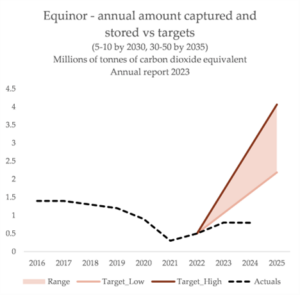
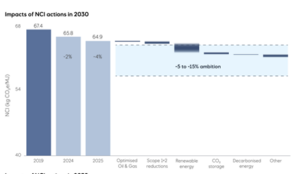
While Equinor don’t disclose their actual capture rate for 2025 in their latest annual report, they do disclose that for the half-year Northern Lights was operational, it captured 0.013 megatonnes of carbon dioxide over that time, about 1% of the site’s total capacity. In their planning out to 2030, their ‘net carbon intensity’ will see more reductions from “Other” than it will from storage carbon dioxide:
Not only are Equinor failing against their targets, they are also joining the broad effort to cash in on highly questionable ‘carbon removal’ offsets, as Equinor are part of a partnership involving controversial bioenergy carbon capture in Denmark.
For many companies around the world, bold ambitions for CCS have been dropped as soon as the possibility of actual consequences for failure were introduced. Norway has, for instance, opposed an effort to introduce a requirement for fossil fuel companies to capture a regulated proportion of their emissions.
And now that climate has dropped in prominence, Equinor is breezily dropping the rhetoric around CCS. Earlier this year, it was reported widely that ”Norwegian energy giant Equinor is pulling back on its investments in CCS projects while costs remain high and markets are not developing as expected”. Blaming a lack of interest in signing long term agreements for carbon storage, we also found that Equinor revealed its capital expenditure in 2026 and 2027 will be reduced by $4 billion, most of which is allocated to its low carbon solutions and power projects”.
Framing their efforts as a “market” in which they are trying to make returns is exactly the wrong way to look at this. Equinor should be forced to clean up their mess whatever it costs them, and when they are faced with the prospect of being forced to do this for even a tiny fraction of their waste, they fight against it. Is there any other industry on the planet that expects to make money from doing the absolute bare minimum amount of social and environmental responsibility? The entitlement is off the charts, and the only thing that grows in size here, is the number of excuses.
The too hard to abate basket
The other constant theme running through the ABC interview is the idea that Norway’s CCS ambitions are serving ‘hard to abate’ sectors – that is, carbon captured from industries like cement manufacturing and steel production, where technological alternatives like electrification and renewables are simply inaccessible to most companies.“It is the hard to abate industries we speak to when we talk about the future need of CCS. It is those hard to abate industries, too, that respond to something else besides the availability of government-sponsored and government-subsidised technology like CCS”
Climate Analytics published a report recently that explains how misleading this framing can be:
“Industry members often use the hard-to-abate label to justify overreliance on offsets and CCS technologies to counterbalance or abate purportedly unavoidable emissions. As this study shows, there are substantial opportunities to reduce emissions relatively quickly in both the iron and steel, and cement sectors, minimising the need for CCS and, over time, resulting in low residual emissions”
My analysis of the latest report from the Global CCS Institute shows that, as per the many years prior, the majority of installed and proposed capacity for CCS facilities around the world are not for ‘hard to abate’ sectors, but for fossil fuels: to dig them up, or to burn them to produce electrical energy and dirty hydrogen.
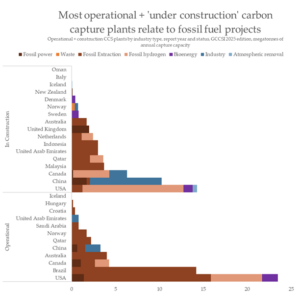
What is happening here is that petrostates are working their way through the CCS acronym. They have broadly given up on the CC part, because capturing carbon is obviously going to be very expensive, and not burning it is way cheaper.
So, Norway and Australia are going to focus on the S instead: ‘storage’.
Norway’s ambassador to Australia is not selling the idea of CCS. They are selling the updated framing and marketing of the real service CCS provides, which is cover for a quasi-progressive petrostate that wants to extract and sell as much fossil fuels as possible, while also receiving global accolades for its climate progress. As Australia prepares for COP31 while dealing with the stunning impacts of a fossil fuel crisis that will bring in massive, barely taxed super profits for fossil fuel companies, it is the worst time ever to be dealing out even more subsidies to technology that does not work.
Ketan Joshi is a Senior Research Associate at the Australia Institute
Advertisement

Related Articles
Australia has significant power in the world, we should be using it more wisely
Australia is not a small nation with no agency.

Pacific nations step up push for fossil fuel phase-out ahead of global talks
Pacific leaders are preparing to meet in Vanuatu to agree on a unified position ahead of the first global conference on transitioning away from oil, coal, and gas later in the year.