Sometimes, the best thing that can happen to a government is to lose a vote in Parliament. Doing so allows a government say, hand-on-heart, that it did everything that it could to fulfill its promises, while sparing that government from the disastrous consequences of its promises.

Wed 3 Dec 2025 00.00
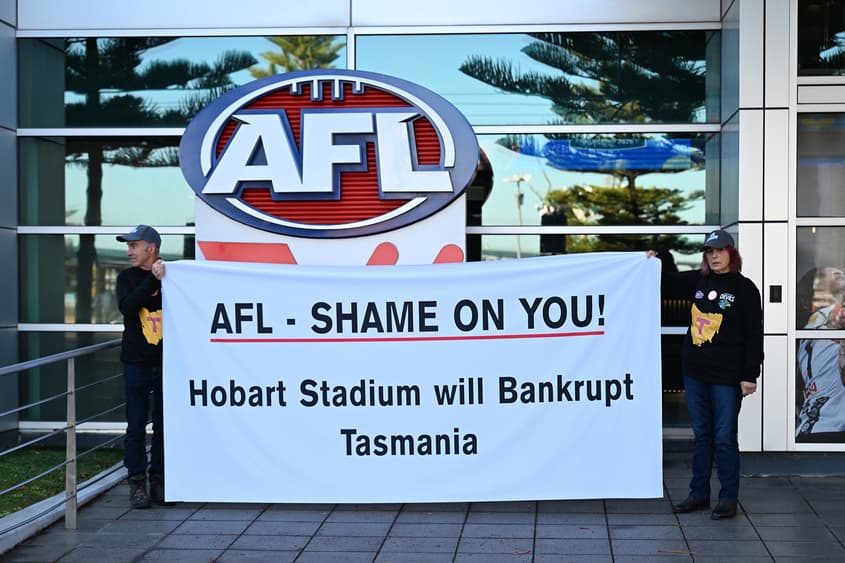
Protesters gather to oppose the proposed stadium development Hobart, Tasmania outside of AFL House in Melbourne, Tuesday, June 10, 2025. (AAP Image/James Ross)


Sometimes, the best thing that can happen to a government is to lose a vote in Parliament. Doing so allows a government say, hand-on-heart, that it did everything that it could to fulfill its promises, while sparing that government from the disastrous consequences of its promises.
This week, the Tasmanian Legislative Council decides whether the Macquarie Point AFL stadium project goes ahead. This is the $1.1 billion dollar stadium to be built in the heart of Hobart, for which the Tasmanian government may be on the hook for $944 million. The state is already projected to be $10 billion in debt by the end of the decade even after Treasurer Eric Abetz has “right-sized” the government by cutting 2,800 public service jobs.
Both the Liberal Government and the Labor Opposition have shackled themselves to the stadium project – undeterred by a “scathing” assessment by the Planning Commission and an independent economist warning it shows the “hallmarks of mismanagement”. With Greens and most independents in the lower house opposed to the project, the stadium could only get up with both major parties voting together.
But Tasmania is unique among Australian jurisdictions in that its upper house, the Legislative Council, is dominated by independents. The Government and the Opposition voting together is not enough to get the stadium passed by the Legislative Council; they need two independents to vote with them as well – in this case, MLCs Dean Harriss and Bec Thomas look to be the deciding votes.
Would Treasurer Eric Abetz be heartbroken if the independents voted no, and saved the state hundreds of millions of dollars? Might Labor Opposition Leader Josh Willie breathe a sigh of relief if Harriss and Thomas sent the state government and the AFL back to the negotiating table?
Australia Institute research shows most Tasmanians think the Parliament should renegotiate to avoid building a new stadium and that the AFL has treated Tasmania unfairly. If the Legislative Council knocks the stadium proposal back, that could strengthen the state’s negotiating position. “I’m right behind you, but I have to keep the radicals happy” is a time-worn bargaining strategy – it is why moderate Liberals found the Nationals so useful.
If the Legislative Council does vote down the stadium project, it will be saving a government from itself. That is a familiar role for an upper house to play. Look at how the Abbott–Turnbull–Morrison Government happily took credit for renewable energy and pollution reduction policies, even though they would have abolished those policies if the Senate hadn’t stopped them.
Winning absolute control can spell death for a government. When Prime Minister John Howard had majority control of the Senate after the 2004 election, he over-reached – including forcing through the unpopular WorkChoices changes to employment rights (forcefully resisted by the “Your Rights at Work” union campaign) and taking partisan control of Senate committees. Howard promptly lost the next election in a “Ruddslide”,including his own seat of Bennelong.
In Queensland, there is no upper house to moderate a majority government, which may explain why Queensland voters tend to “swing hard”. The ideological projects, rush jobs and misguided promises that an upper house would have blocked or cleaned up, instead sail through – and voters take notice. Look at the “shellacking” the one-term Liberal–National Premier Campbell Newman copped in Queensland in the 2015 election, after unpopular asset sales, 12,000 public service jobs cut and the “gutting” of the Crime and Corruption Commission. Newman’s replacement, Labor Premier Annastacia Palaszczuk, had the benefit of winning only minority government in her first term; while having to negotiate with independent and Katter Party MPs would not have felt like a blessing, in retrospect it may help explain her long tenure.
Of course, when a party’s MPs are prepared to speak up against unpopular and ill-advised policies, they can improve their own government – regardless of which house they are in. The Labor Party once had a much stronger tradition of party room debate; academic Chris Wallace explains: “Caucus used to be a place where vigorous disagreement could occur in a group setting, with MPs joining in spirited debate on contentious issues”, allowing for flawed policies to be corrected. In the Liberal and National parties, free-thinking backbenchers have crossed the floor hundreds of times, in particular restraining the Fraser Government after it won a Senate majority following the Dismissal.
Australian governments wield great power, and are subject to few constraints. Upper houses exist to scrutinise, oversee and rein in those governments. That protects the public from government abuse of power, but it also protects governments from overreaching. If independents in the Tasmanian Legislative Council vote down the unpopular white elephant that is Macquarie Point stadium, they will be doing a service not just to the Tasmanian people, but to the Liberal Government as well.
Bill Browne is the director of the Australia Institute’s Democracy & Accountability Program.
Early on in his prime ministership, John Howard stood in front of Australia’s Indigenous leaders and told them he would not apologise for Australia’s past.

Electoral reform advocates are calling for the Albanese Government to follow the lead of state Labor governments and remove political parties from Australia’s federal postal vote process.

Looking for a break from federal politics? The South Australian election will take place on 21 March this year, and will be a proving ground for national political trends like the rise of One Nation and experiments with political donation laws.

The latest voter polling gives the Malinauskas Labor Government a commanding lead one month out from the 21 March state election in South Australia. South Australia does not need a strong Opposition party, but it does need a strong Parliament. As sensational as a Liberal lower house wipe out would be, it is in the upper house where a Labor landslide would have the most immediate effect.