If the Liberals are wiped away, what will remain in South Australia?
The latest voter polling gives the Malinauskas Labor Government a commanding lead one month out from the 21 March state election in South Australia. South Australia does not need a strong Opposition party, but it does need a strong Parliament. As sensational as a Liberal lower house wipe out would be, it is in the upper house where a Labor landslide would have the most immediate effect.

Wed 25 Feb 2026 23.00
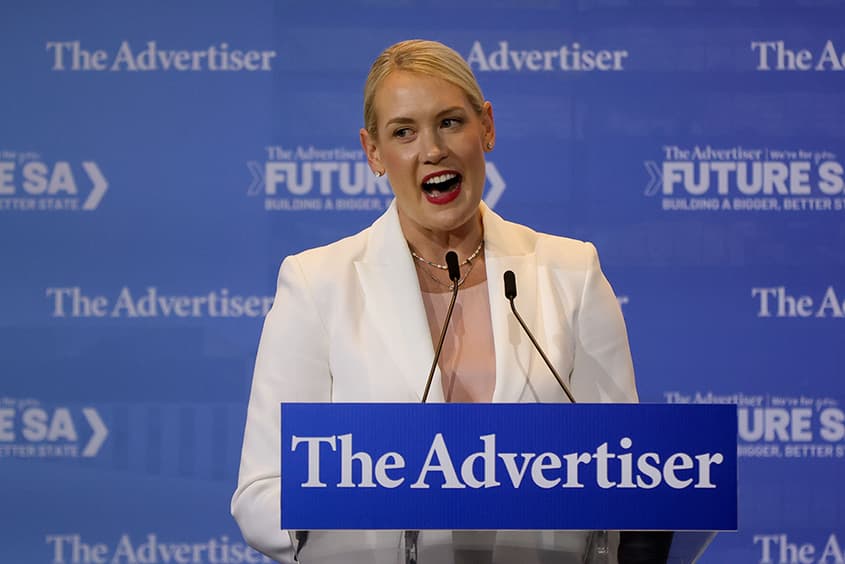
Photo: Opposition Leader Ashton Hurn during a South Australian leaders debate at The Advertiser’s Future SA event, in Adelaide, Friday, February 20, 2026. (AAP Image/Matt Turner)


The latest voter polling gives the Malinauskas Labor Government a commanding lead one month out from the 21 March state election in South Australia.
Labor polled 44% of first-preference votes, three times the Liberals (14%) and well ahead of One Nation (24%). The Greens are on 12%. If those results occurred on election day, Labor would win almost all of the state’s 49 lower house seats, even with preferential voting. Liberals would win one or perhaps no seats, and One Nation just a handful.
South Australia does not need a strong Opposition party, but it does need a strong Parliament. As sensational as a Liberal lower house wipe out would be, it is in the upper house where a Labor landslide would have the most immediate effect. If Labor wins five of the 11 upper house seats up for grabs, they will need just one crossbencher vote to pass legislation.
The upper house is already friendly to Premier Peter Malinauskas, waving through his unfair and rushed changes to electoral law and otherwise proving reluctant to hold inquiries into proposed government legislation or to interrogate the government.
Those electoral law changes will make South Australian elections much less competitive. The basic idea behind the changes is that political donations are banned, and in compensation the major parties and sitting MPs get enough taxpayer funding to fully fund their administration costs and election campaigns.
But what happens if there is only one major party in the state, and if four in every five sitting MPs are government members?
A challenger like One Nation is limited in how much public funding it can receive, so it – and any new political parties and independents that emerge to fill the void left by the Liberals – will struggle in this and future elections against the taxpayer-subsidised juggernaut that is SA Labor.
So while in the short term it is the upper house race that will decide whether there are any constraints on the Malinauskas Government in its second term, the lower house race matters as much for the long-term competitiveness of the political parties.
A poor result at next month’s election could limit the Liberals’ ability to rebuild, at the same time that Premier Malinauskas’ donation ban makes it impossible for any competitor to reach the multi-million-dollar a year revenue that seems to be necessary for a modern “party of government”.
The Liberal Party is not entitled to special treatment. As former Liberal MP Keith Wolahan wrote this week, “No political party has a right to survive.” If Liberals get a miserable 14% of the vote, that is a message from South Australians that the party is off track.
But it still seems reasonable that the Liberals win around 14% of the seats. Instead, 14% of the vote translates to perhaps zero or one seat (2% of all seats).
If 44% of South Australians choose Labor for their first preference (and many more give Labor their preferences), no one would begrudge the party about 44% of the seats, maybe a bit more.
But it is not reasonable for Labor to win 80% or 90% of the seats from 44% of the vote. That outcome would be an artefact of South Australia’s “winner-takes-all” approach, where each of the 49 lower house seats goes to whichever candidate gets a majority in that seat.
A fairer electoral system already exists. In the ACT and Tasmania, the lower house is elected from “multi-member electorates”. Each voter has five local members in the ACT, and seven in Tasmania, chosen proportionally according to vote share in that seat. The result is a proportional parliament where power is shared between parties and independents relative to their true support among the public. In South Australia, it might look like 10 electorates of five members each – balancing local representation with a diversity of voices.
As for political funding laws, again there is a working model elsewhere. Instead of paying political parties based on how big their campaigns were and how many votes they received, candidates could be funded based on their outreach and current support. In the City of Seattle, a “democracy voucher” system gives citizens the power to distribute public funding.
On first blush, the South Australian election looks like a done deal for a popular first-term premier and a resurgent Labor Party. But the scale of that victory will be exaggerated by the disproportionate voting system and the unfair allocation of taxpayer funding. Changing to a more proportional lower house and placing public funding in the hands of voters would strengthen South Australian democracy in the longer term, without denying Labor a deserved victory that reflects their popular support.
Bill Browne is democracy & accountability program director at the Australia Institute
Advertisement

Related Articles
Popular policies would be a better revenue raiser than taking fossil fuel and gambling donations
Australians are naturally suspicious of corporate donations, especially when they come from vested interests with everything to gain from influencing government decision-making. But are these donations large enough to explain why politicians act the way they do? The reality is that political donations from harmful industries are small relative to the payments parties receive from you, the voter.