Locals are gearing up for a new fight against offshore gas expansion, with a Torquay paddle-out opposing acreage releases in the Otway Basin.

Wed 4 Feb 2026 14.00
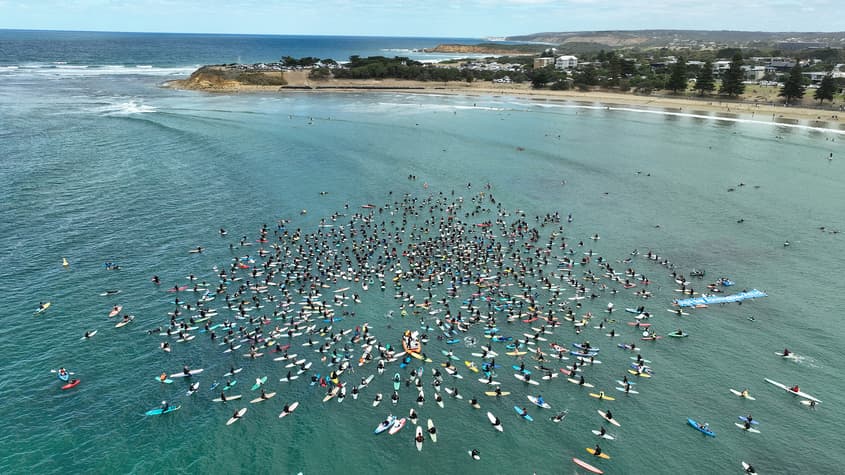
Photo: Surfrider Australia


In 2024, communities from Victoria to Tasmania won a rare environmental victory. Against the odds, they stopped a multinational fossil fuel company from conducting 3D seismic blasting over 77,000 sq. km of the Otway Basin. The proposal by TGS threatened endangered whales feeding grounds, fragile marine ecosystems, marine parks and coastal communities whose culture and livelihoods are inseparable from the ocean.
Over two intense years, tens of thousands of public submissions, sustained local protests and national campaigning, and widespread opposition from impacted industries forced the project’s withdrawal in September 2024. It was a reminder that informed, organised communities can still hold the line when governments fail to represent them.
Just over a year later, that fight has returned.
On 11 December 2025, the Albanese Government quietly opened five offshore blocks in the Otway Basin for gas exploration bidding. The announcement came from Minister for Resources and Northern Australia Madeleine King and forms part of the Government’s Future Gas Strategy. It is also linked to plans to expand carbon capture and storage (CCS) in the region linked to the Otways CO2CRC.
These acreage releases are not the result of a law debated or passed by Parliament. It is an administrative acreage release, initiated at the request of the fossil fuel industry. Companies lobby governments for access to the commonwealth administered ocean, and governments comply. The process reflects industry priorities not public interest.
Granting fossil fuel exploration permits lays the groundwork for what communities fought to stop over the past five years. Seismic blasting, drilling, and eventual extraction all begin with these permits. Unlike a single project proposal, an acreage release functions as a blanket invitation. It allows companies to stake claims over large sections of ocean before specific plans are made public. Once permits are issued, the expectation of development becomes embedded in law, making future opposition harder and riskier.
The Otway Basin is not an abstract patch on a map. It borders internationally significant whale migration routes, supports diverse marine life, and underpins coastal economies reliant on tourism, fishing, and deep cultural connections to Sea Country. What happens offshore shapes life onshore.
 Photo credit: Ula Majewski
Community opposition is already re-emerging. On 31 January, communities across southwest Victoria gathered in Torquay for a paddle-out protest opposing the acreage release and further offshore gas expansion. But the Government has given the public barely any time to respond. The areas were released just weeks before Christmas, with submissions closing on 5 February, 2026.
That consultation window coincided with extreme heatwaves and catastrophic bushfires across parts of southeast Australia, particularly the Otway region. Communities in the Otways facing dangerous conditions, evacuations, loss of homes and the very real impacts of a climate crisis intensified by burning gas are living the real impacts of fossil fuel driven climate emergencies.
While people are protecting homes and lives, the Government is asking them to quietly comment on plans to expand the industry driving those disasters.
Even if commercially viable gas were discovered, it would not help Australia’s energy system any time soon. Exploration, appraisal drilling, approvals, infrastructure construction, and market connection take many years. New offshore gas would not come online for at least a decade, if it comes online at all. Analysis by the Australia Institute shows under Australia’s current gas export settings, around 80 per cent of that gas would be shipped overseas.
That export bias has already pushed domestic gas prices higher by linking Australian households and manufacturers to volatile international markets, worsening energy insecurity rather than easing it.
This is not a supply problem. Australia has more than enough gas. It is a policy failure that allows multinational gas companies to ship most of the gas overseas while Australian households and businesses pay international prices for their own resources.
By the time any new offshore gas might flow, Australia’s energy system will be well into renewable transition. Domestic demand for fossil gas is declining, not growing. These acreage releases are not about solving immediate energy needs or lowering power bills. They are about extending the life of an industry already in structural decline.
This approach also sits in opposition to Australia’s international climate commitments. At COP30 in Belém, the government signed onto a global agreement to phase out fossil fuels. Offering new sections of ocean to the fossil fuel industry now, potentially locking in decades of future extraction, undermines that pledge and sends a clear signal about whose interests are being prioritised.
The Otway seismic blasting battle showed what is possible when communities are informed and persistent. It also showed that public opposition can force governments and corporations to retreat. That lesson applies again now.
The Albanese Government holds a parliamentary majority and a mandate from voters. That mandate was not granted by the fossil fuel lobby. They have both the power and the responsibility to stop issuing new offshore exploration rights and to put Australia decisively on the path to a fossil fuel phase-out.
Constituents are watching closely. History will remember whether their elected representatives acted with bravery in the public interest, or once again chose to extend the life of fossil fuel interests that should be wound down.
Advertisement

New South Wales is the first state in Australia to ban new coal mines. The State Government announced on Friday that it will no longer consider applications for new mines or allow new coal exploration, while extensions to existing mines will still be considered.
Australia is already paying the price of climate change. The evidence appears almost daily on the national emergency map. Just this week alone, major flooding has inundated communities in Queensland, with homes and businesses flooded in Bundaberg. Flooding across the Northern Territory has forced evacuations in remote communities.
The Federal Government is facing calls to intervene and stop the expansion of a central Queensland coal mine that environmental groups have labeled a “carbon bomb”.