Albanese is happy to challenge the status quo, but reform seems a step too far
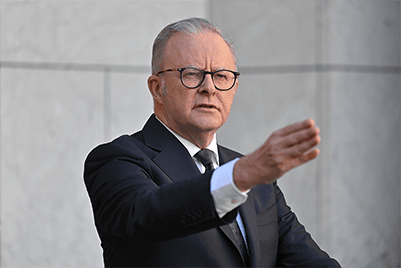
Seeking to reassure the Australian public in his most recent Press Club address, Anthony Albanese borrowed from populism. “There is no security in maintaining a status quo that doesn’t work for people,” he said. However, he has so far been unable to bring himself to take the next step. Reform.

Mon 13 Apr 2026 16.15
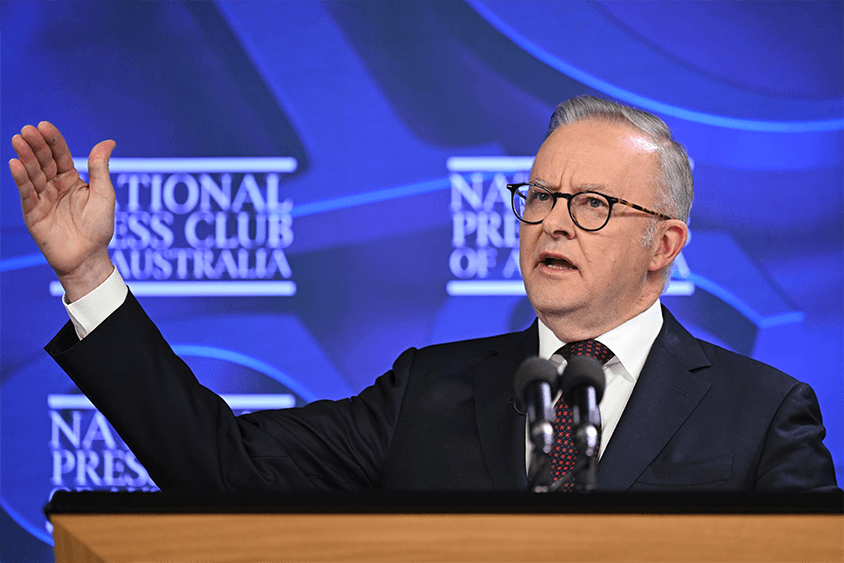
Photo: AAP Image/Lukas Coch


Seeking to reassure the Australian public in his most recent Press Club address, Anthony Albanese borrowed from populism.
“There is no security in maintaining a status quo that doesn’t work for people,” he said.
Albanese was speaking in the context of how the federal government was moving to shore up the domestic economy, and the new agreements it was signing with partners like the European Union.
As I write this, he is in Singapore attempting to find new lines of fuel supply for Australia. Because despite what the government says publicly, it is preparing for the long-term economic impacts of the United States and Israel’s decision to bomb Iran.
Australia is not alone in this stance – the latest World Uncertainty Index, which monitors 143 countries, reported a spike, similar to that seen in January 2008 when the US Federal Reserve made an emergency cut to its cash rate to try and fend off what became the Global Financial Crisis.
We don’t know what will happen, but now that the inevitable consequences of Israel’s actions, backed by the US, are having ongoing economic implications for most of the world, we are looking for an exit ramp.
The death of tens of thousands of civilians was not enough to move governments, but economic downturns always tend to move what paralyses ethics, values and moral lines.
Milton Friedman, the granddaddy of neoliberalism who advised Chilian dictator Augusto Pinochet in the mid-1970s, was not right on much but he did identify how to exploit a crisis.
In the oft-quoted preface to his 1982 edition of Capitalism and Freedom, Friedman said:
“Only a crisis — actual or perceived — produces real change. When that crisis occurs, the actions that are taken depend on the ideas that are lying around. That, I believe, is our basic function: to develop alternatives to existing policies, to keep them alive and available until the politically impossible becomes the politically inevitable.”
In 2026, we are living with the consequences of Friedman’s regime, which Albanese called the status quo.
But while Albanese, like most politicians looking to maintain their popularity among voters, is happy to use the language of the populist – “there is no security in maintaining a status quo that doesn’t work for people” – he has so far been unable to bring himself to take the next step. Reform.
Australia’s ‘deep concerns’ over Israel’s ‘Operation Eternal Darkness’ which, as of writing had thrown the tenuous two-week ceasefire with Iran into doubt when it attacked 100 sites across Lebanon in 10 minutes, killing and wounding hundreds of civilians, came just as Albanese was about to fly to Singapore to try and ensure a fuel supply into May and beyond.
Foreign Minister Penny Wong joined with counterparts in the global south as well as traditional allies calling for Lebanon to be included in the ceasefire, despite the US and Israel claiming it was not part of the deal.
Albanese backed that in, saying before he left that the Australian government “also firmly believes” the ceasefire “has to apply to Lebanon as well.”
“We want to see peace in this region, and it will make a difference,” he said.
So the fuel crisis means Australia’s government is willing to go further in making principled positions, not human misery, not the deaths of men, women and children, not the territorial take over of sovereign land – it’s the economic blowback.
We should sit with that as a nation. Petrol prices have taken precedence over human life.
Wong all but belled that cat on ABC radio Thursday when she said: “We want the ceasefire to hold. We know it’s fragile. We know what it means for the world and we know what it means for Australians at the petrol bowser.”
So a crisis has seen a diplomatic shift, but what change is the government actually prepared to make about that ‘status quo’ in Australia?
The answer, at this point, seems to be – not much.
While borrowing from the language of populists and predictably responding to a growing economic crisis, Albanese has also dismissed those calling for change in Australia as populist – variously labelling Andrew Hastie, David Pocock and others with the label for something he himself is striving for – popularity.
It’s proving so popular that even One Nation has (in an accidental leak first published by The Australian) jumped on board.
Just because an idea is popular doesn’t make it automatically terrible, especially if it’s popular with voters across the political spectrum.
But that would require challenging the status quo, which an incrementalist like the current Prime Minister has so far shown himself hesitant to do.
Albanese talks about a status quo that is not working while dismissing ideas like the ACTU’s proposed 25 per cent tax on gas exports to replace the failed Petroleum Resource Rent Tax, despite the opportunities to raise much needed revenue.
Instead, domestic changes have centred around the need to prepare for cuts to the NDIS and ‘tighten’ spending, a standard not applied to fossil fuel subsidies or defence spending (the cuts there are to make way for increased spending in other areas within that portfolio).
Albanese is right to identify that the status quo isn’t serving people. It was promising more of the status quo that saw Donald Trump elected in America over a challenger who was promising more of the same.
If a crisis is what is needed to produce change, and if the change comes from ideas ‘lying around’ as Friedman identified, then Albanese has answers.
How big the crisis has to get before he reaches for them is something else altogether.
Amy Remeikis is a contributing editor for The New Daily and chief political analyst for The Australia Institute
This article was first published on The New Daily.
Advertisement
Related Articles
Popular policies would be a better revenue raiser than taking fossil fuel and gambling donations
Australians are naturally suspicious of corporate donations, especially when they come from vested interests with everything to gain from influencing government decision-making. But are these donations large enough to explain why politicians act the way they do? The reality is that political donations from harmful industries are small relative to the payments parties receive from you, the voter.