Popular policies would be a better revenue raiser than taking fossil fuel and gambling donations
Australians are naturally suspicious of corporate donations, especially when they come from vested interests with everything to gain from influencing government decision-making. But are these donations large enough to explain why politicians act the way they do? The reality is that political donations from harmful industries are small relative to the payments parties receive from you, the voter.
Sat 11 Apr 2026 01.00
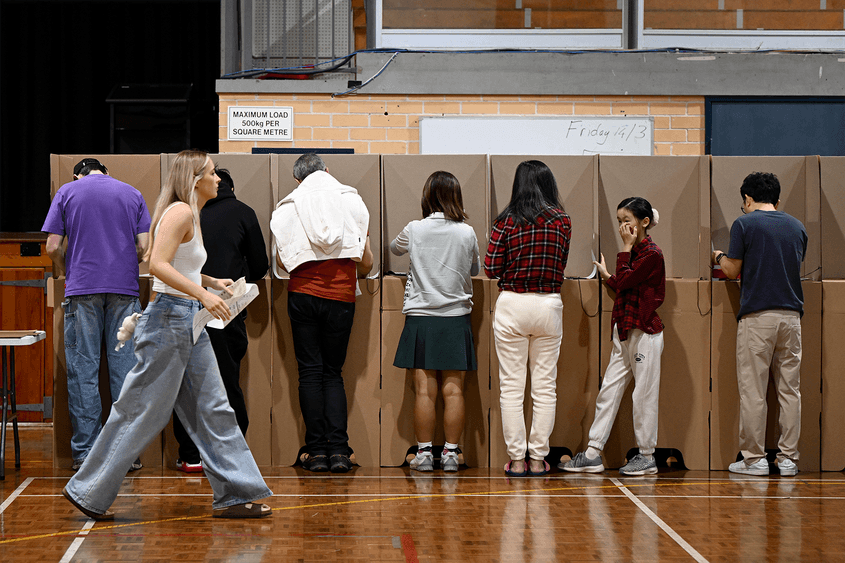
Photo: AAP Image/Bianca De Marchi


Australians are naturally suspicious of corporate donations, especially when they come from vested interests with everything to gain from influencing government decision-making.
But are these donations large enough to explain why politicians act the way they do?
The reality is that political donations from harmful industries are small relative to the payments parties receive from you, the voter.
Australia provides taxpayer funding to parties and candidates based on how many votes they receive. At the May 2025 federal election, each voter was worth around $6.80 in public funding, and that will rise to $10 at the next election – that’s $5 each for ballots for the House of Representatives and Senate.
It pays to be popular. Winning the vote of an extra 1% of Australians (about 160,000 people) is worth $1.1 million, set to rise from next year to $1.6 million.
Corporate donations are small compared to taxpayer funding of political parties
Public funding is worth much more to the political parties than political donations from any industry.
In the year leading up to the 2025 federal election, fossil fuel interests gave $1.1 million to the Labor Party and $2.9 million to the Liberal–National Coalition. Banks, management consulting firms and alcohol companies gave hundreds of thousands of dollars, and the gambling industry gave in excess of a million dollars.
In other words, taxpayer funding of political parties exceeds fossil fuel funding by at least 10 to 1, and the ratio is even higher for gambling, private health, and banking donations.
And what has catering to these corporate interests over the wishes of the public cost the major parties?
Well, Labor and the Liberal–National Coalition have together lost 18% of the vote since Kevin Rudd flubbed “the great moral challenge of our generation”, fighting climate change, in 2009. If the major parties won back their 2007 vote shares at the next federal election, that alone would be worth an extra $11 million to Labor and $16 million to the Liberal–National Coalition – at which point fossil fuel donations would look like little more than a rounding error.
Winning votes might be a better strategy than wining and dining the rich
The enormous amounts of money available to political parties for winning votes do strange things to the dynamics of fundraising.
Then Liberal Opposition Leader Peter Dutton famously left his home state of Queensland while a cyclone was approaching to attend a fundraiser at the harbourside mansion of billionaire Justin Hemmes.
It’s unknown how profitable that was, but it is plausible that the votes Mr Dutton lost by attending that controversial fundraiser cost the Liberals more than the fundraiser raised.
Major parties are increasing taxpayer funding to compensate for their declining vote share
Labor and the Liberal–National Coalition do not need to increase their vote share to receive more taxpayer funding.
They can just change the law so that each vote is worth more money. Indeed, going from $3.40 a vote to $5 a vote is worth about $33 million per election to the major parties – more than compensating them for the $18 million they were out last election due to declining vote share.
No wonder Labor and Liberal voted together in early 2025 to increase public funding to $5 a vote and to change the fundraising rules to make it harder for new entrants to challenge incumbents.
But by increasing the payment per vote, the financial benefits of winning more votes are even greater for political parties and candidates. Winning back their 2007 vote share would now deliver an extra $27 million in public funding to the major parties each election.
Lack of political will, not political donations, explains lack of progress
It is a comforting myth that Australia’s inaction – whether on climate change, gambling, or public health – can be blamed on corrupting corporate donations. The myth serves and is spread by the politicians whose parties accept those donations, because by appearing powerless they can avoid taking responsibility.
The reality is that political donations are small beer compared to the dollars that the major parties are bleeding in lost vote share thanks to their determination to support harmful industries like fossil fuels and gambling.
Related Articles
'Perfectly legal to lie': report exposes gaps in political ad laws
The Australian Ad Observatory report has warned that online political messaging in Australia “remains murky territory, lacking in transparency and accountability.”